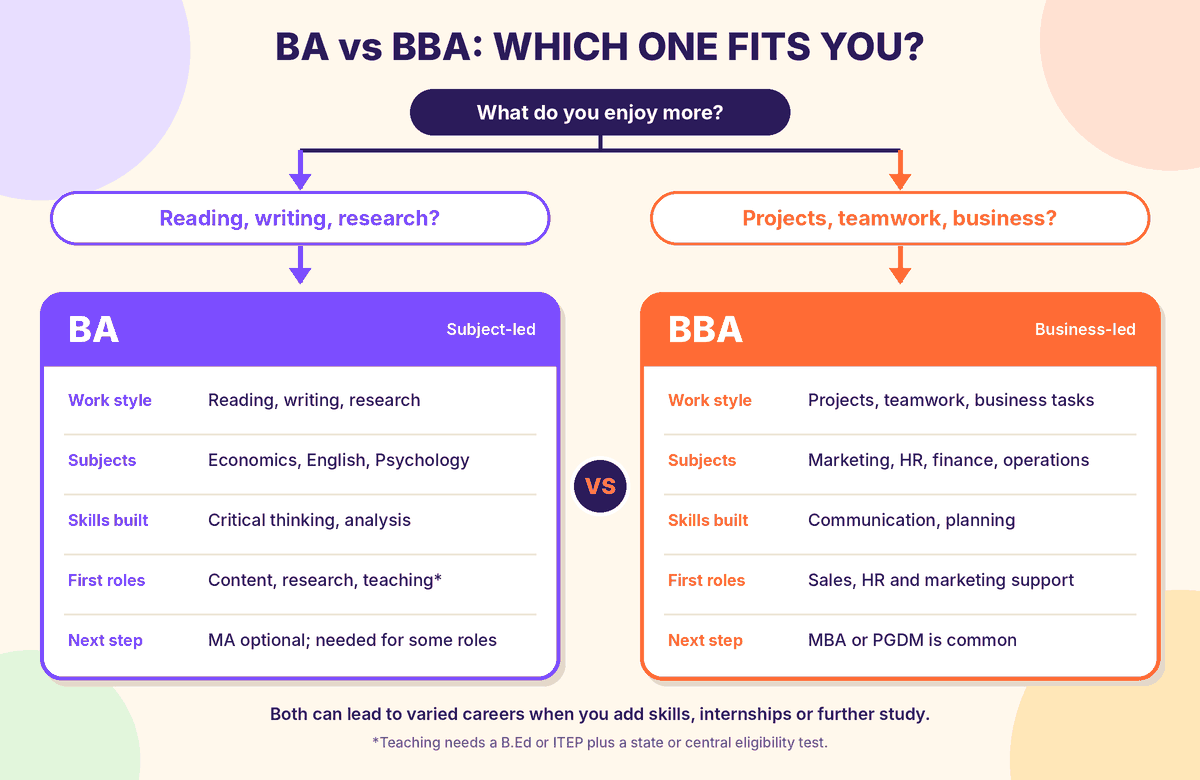
Course | Work style | Subjects | Skills built | Typical first roles | Postgraduate step | Best for |
BA | Reading, writing, research, discussion | One or more disciplines like Economics, English or Psychology | Critical thinking, writing, analysis | Content, research support, teaching (after the required qualification), social-sector roles | Optional, but needed for some roles | Students who like a subject or a later specialist route |
BBA | Projects, teamwork, business tasks | Management, marketing, HR, finance basics, operations | Communication, planning, basic business skills | Sales, marketing support, HR support, operations coordination | Optional; MBA or PGDM is common | Students who like business and corporate entry roles |
Decision box
Choose BA if you like a subject area, research, public affairs, writing or social sciences, or want a later specialist route.
Choose BBA if you like business functions, management basics, projects and corporate entry roles.
Remember: Both can lead to varied careers when you add skills, internships or further study.
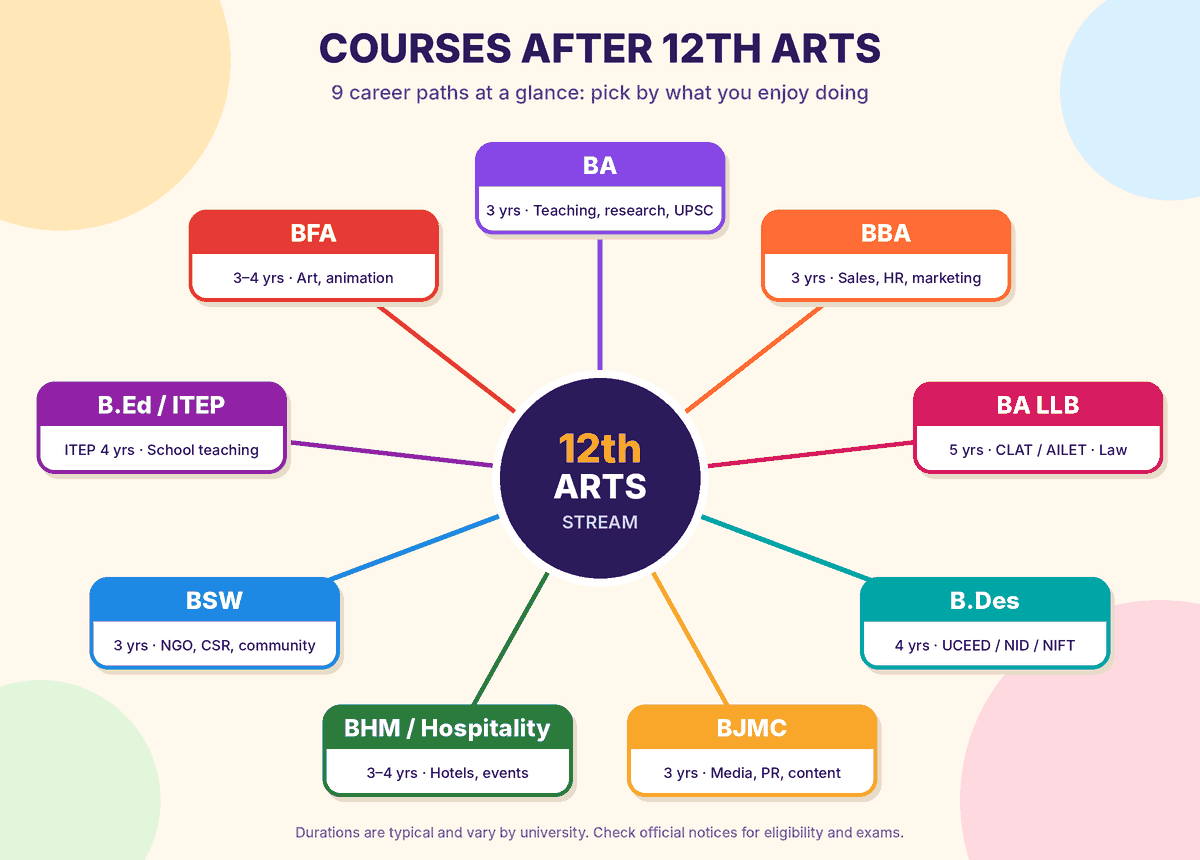
Other strong courses after 12th arts
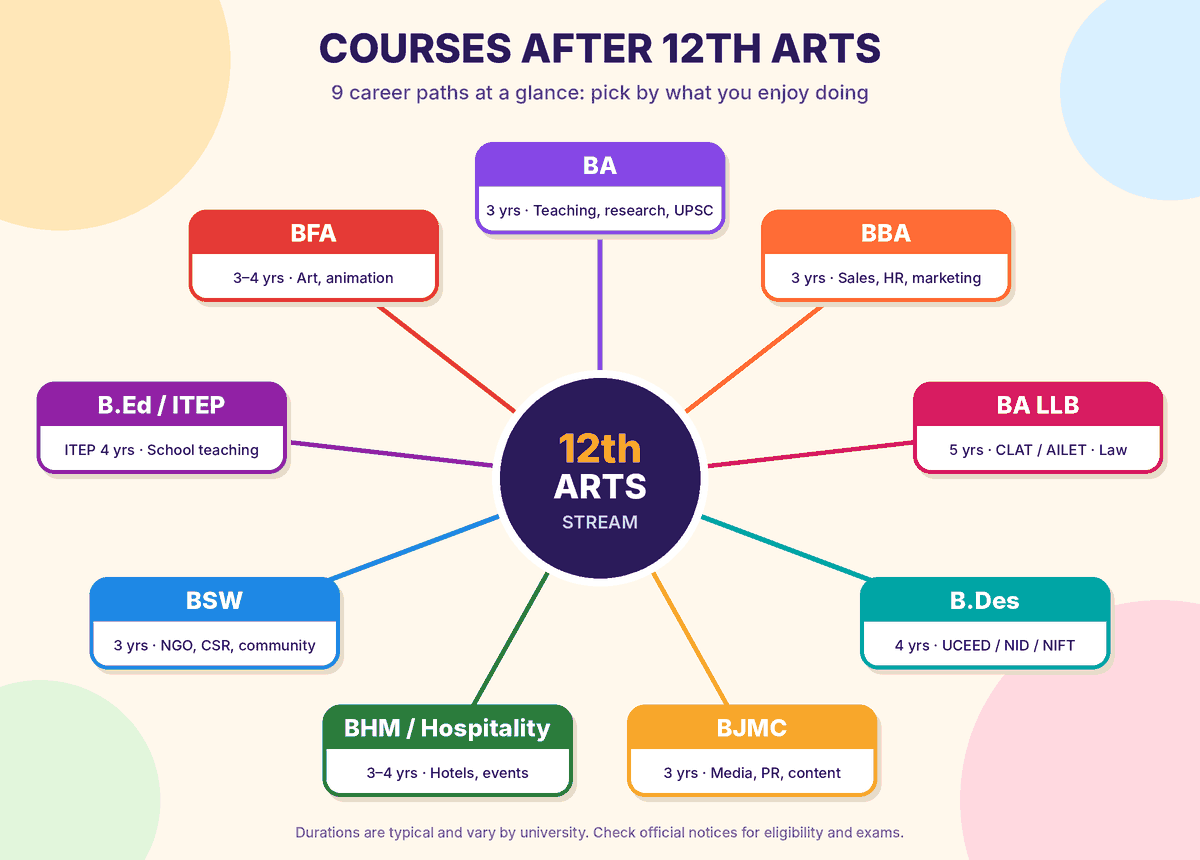
Beyond BA and BBA, arts students can pick professional and creative paths. A quick search for arts students courses after 12th can feel confusing because so many options appear. You will also see diploma courses after 12th arts in areas like design, media or hospitality, which are shorter options. Entry rules, aptitude tests and course length vary, so always check the official notice.
Professional routes: Law is the most common example. It usually needs an entrance exam and a five-year integrated degree.
Creative routes: Design and fine arts look at aptitude, drawing skills or a portfolio, and not only your marks.
Career-specific routes: Media, hospitality and social work lead more directly to certain job types than a general degree.
Teaching routes: Teaching follows a set degree sequence, which is explained below.
Entrance-based routes: law, design and fine arts
Law courses after 12th arts and fine arts courses after 12th both depend on entrance exams or aptitude tests. No single exam covers every college, so check each institute.
Course | Common exams or routes | Things to know |
BA LLB | CLAT, AILET and university tests | CLAT covers many National Law Universities. AILET is for NLU Delhi. Some universities run their own tests. |
B.Des | UCEED, NID DAT, NIFT, depending on the institute | Each exam has its own participating institutes and format. |
BFA | Aptitude test, portfolio or institution-specific selection | Drawing skills and a portfolio often matter more than marks. |
Always confirm current participating institutes and eligibility on each exam’s official website.
Media, hospitality and social work
These courses lead to specific job areas. They are not a promise of a particular post right after graduation.
Course | What it is about | Notes |
BJMC | Journalism, media, communication and PR | You may start as a trainee, reporter or content writer, not as an editor. |
BHM / BSc Hospitality | Hotel and service operations | NCHM JEE is the route for participating hospitality institutes. |
BSW | Social-sector and community work | Often leads to NGO, CSR and community program roles. |
Teaching routes
B.Ed generally follows an undergraduate degree. It is not a direct Class 12 course. The newer four-year Integrated Teacher Education program (ITEP) offers an integrated route where available.
B.Ed after a degree: You finish a bachelor’s degree first, then apply for B.Ed. Admission rules differ by state and university.
ITEP after Class 12: ITEP is a four-year integrated program under NCTE rules. Admission is through the National Common Entrance Test (NCET) at participating institutions.
Check recruitment rules: Teaching job rules can change, so check the current NCTE and recruitment notices before you choose a route.
What about BCA and B.Com?
Arts students are eligible for BCA and B.Com at some institutions, not all. Others ask for Mathematics, Accountancy, Business Studies or other specific subjects.
Check subject rules: Read the official admission notice. Do not rely on general statements like “all students can apply.”
Check course by course: One university may accept arts students into B.Com, while another may not.
Plan early: If you want BCA or B.Com later, check the subject rules while you are still in Class 11 or 12.
Entrance exams worth preparing for
Not every BA or BBA needs an entrance exam. Requirements depend on the institution and program. Some admit on Class 12 marks. Others use national or university-level tests. This is also true for many of the courses for arts students after 12th.
Exam | Courses | When to start preparing | Official source |
CUET UG | BA and other UG programs at participating universities | Class 11 or early Class 12 | NTA CUET website |
CLAT | BA LLB at participating NLUs | Class 11 or early Class 12 | Consortium of NLUs |
AILET | BA LLB at NLU Delhi | Class 11 or early Class 12 | NLU Delhi |
UCEED | B.Des at participating institutes | Class 11 or early Class 12 | IIT Bombay (UCEED) |
NID DAT | B.Des at NID | Class 11 or early Class 12 | NID |
NIFT entrance | Design and fashion programs at NIFT | Class 11 or early Class 12 | NIFT |
NCHM JEE | BSc Hospitality at participating institutes | Class 12 | NTA and NCHM |
IPMAT | Integrated management programs at selected IIMs | Class 11 or early Class 12 | Official IIM IPMAT pages |
Dates, eligibility and participating institutes change each year. Check the official notice for the current session before you apply.
Preparation note: Law and design applicants should look at the syllabus, aptitude format and portfolio rules early. Class 11 or early Class 12 is a good time to start. Not everyone needs the same preparation time.
High-paying careers after 12th arts: which routes pay more, and why
Many students search for high salary courses after 12th arts. Higher-paying careers usually sit behind one of three gates. The first is an entrance-gated degree, like law or design. The second is postgraduate study, like an MBA. The third is a skill built during the degree, like analytics or UX. Pay still varies by employer, location and experience.
Careers that tend to pay more, and the route into each
People often look up courses after 12th arts with high salary, as well as govt courses after 12th arts with high salary. The table below shows routes and what raises pay. It does not give salary numbers, because pay changes by employer, city and experience. Law courses after 12th arts, for example, lead to a lawyer’s career only after the degree and the required enrolment.
Career | Route from 12th arts | Extra step needed | What drives pay up |
Corporate lawyer | BA LLB after an entrance exam | Enrolment and practice requirements | Firm, specialisation and experience |
UX/UI or product designer | B.Des or a design course | Strong portfolio | Portfolio quality and tools |
Marketing or brand manager | BBA or BA, then MBA often | MBA or PGDM is often useful for management growth | Campaign results and experience |
HR manager | BBA or BA | MBA in HR is often relevant | Experience and team size |
Business or data analyst | BBA or BA Economics | Skills in Excel, SQL or BI tools | Tool skills and domain knowledge |
Civil services officer | Any recognised degree | UPSC selection process | Rank, service and seniority |
Clinical psychologist | BA Psychology | Postgraduate training and applicable registration | Experience and setting |
Journalist or content strategist | BJMC or BA | Portfolio of published work | Reach, skills and experience |
Hospitality manager | BHM or BSc Hospitality | Hands-on experience | Property, role and experience |
Check regulated pathways with the Bar Council of India and RCI, and civil services rules with UPSC.
Why published salary figures disagree
Salary numbers for the same course differ because they measure different things. Some surveys include only people who choose to share, and colleges often show only the highest package, not what most students earn.
Averages can also mix new graduates with senior staff. Pay changes by city and college too. So if a figure has no source, year or sample size, treat it as advertising.
A simple rule: treat any figure without a source, year and sample as a promotional claim.
What actually moves pay for arts graduates
Pay is shaped less by the stream you studied and more by what you build around it. High salary courses after 12th arts depend more on these levers than on the degree name.
Course-level placement data: Look at the data for your exact program, not the whole university.
A relevant postgraduate step: Some careers, like management or clinical psychology, need further study.
Internships: Real work experience makes your profile stronger when you apply.
Portfolio or case work: Design, writing and marketing roles often hire on samples of your work.
A transferable skill: Skills like data handling, writing or sales help in many roles.
City and industry: Pay differs by location and sector, so research your target field.
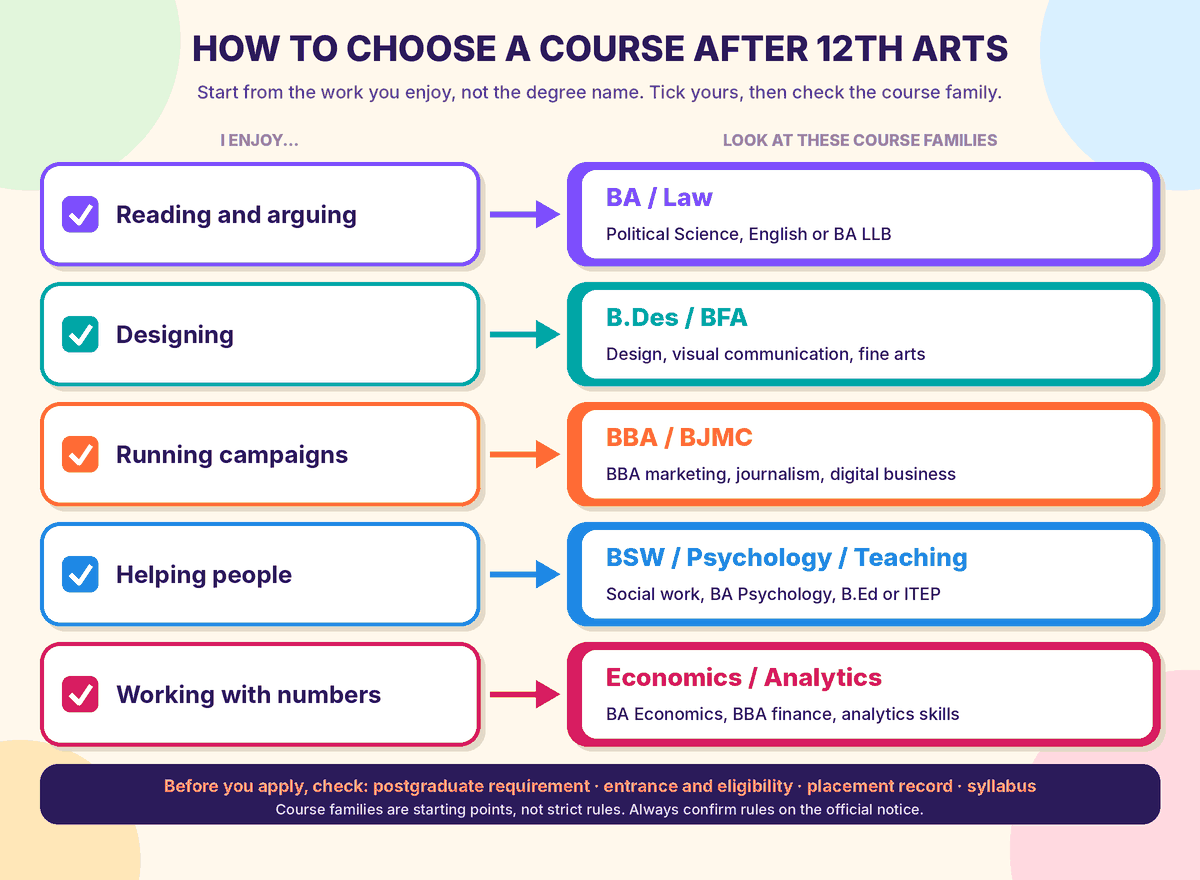
How to choose the right course after 12th arts
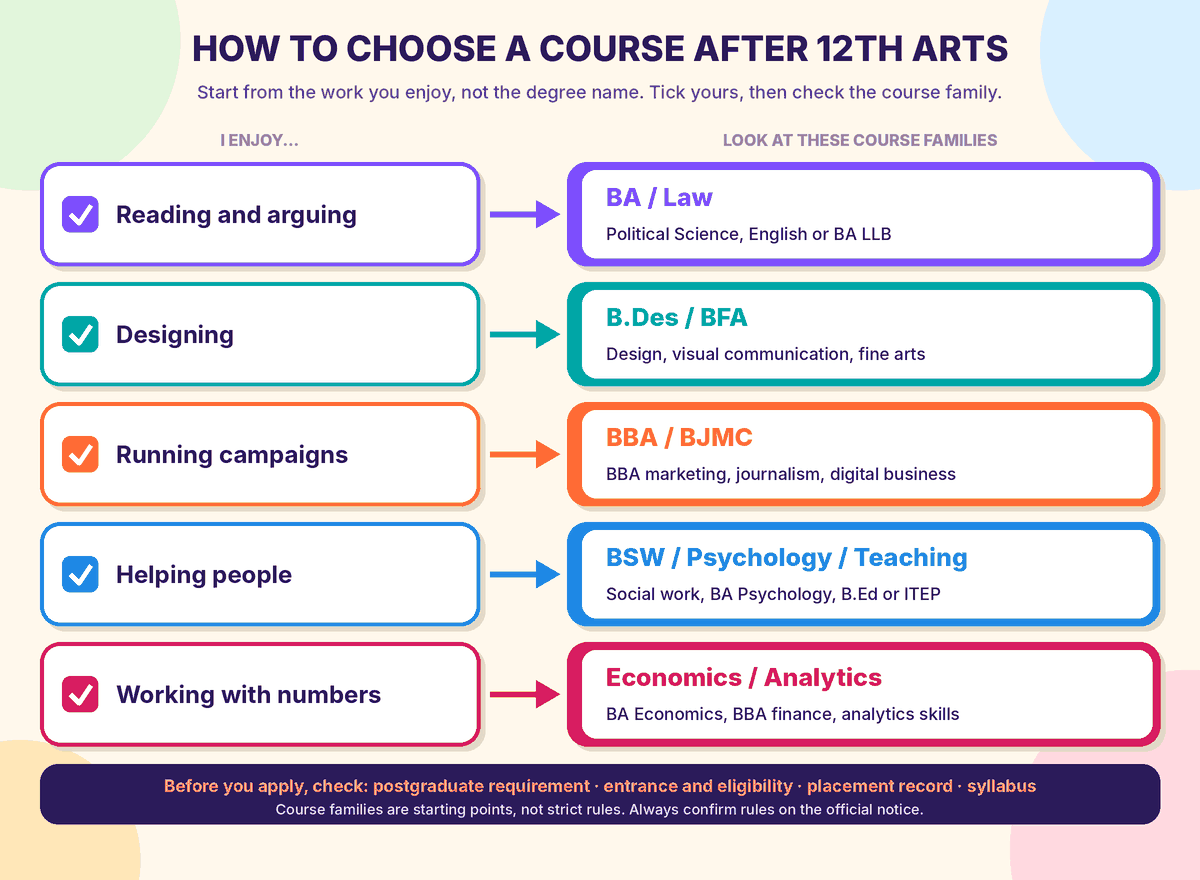
After 12th arts, which course is best for the future? The honest answer is that it depends on you. Start with the kind of work you want to do. Then check eligibility, entrance rules, course quality and the extra skill or qualification the career needs. The best courses after 12th arts are the ones that fit your goals.