See the top skills you gain from an online MBA that companies value.
Basic eligibility
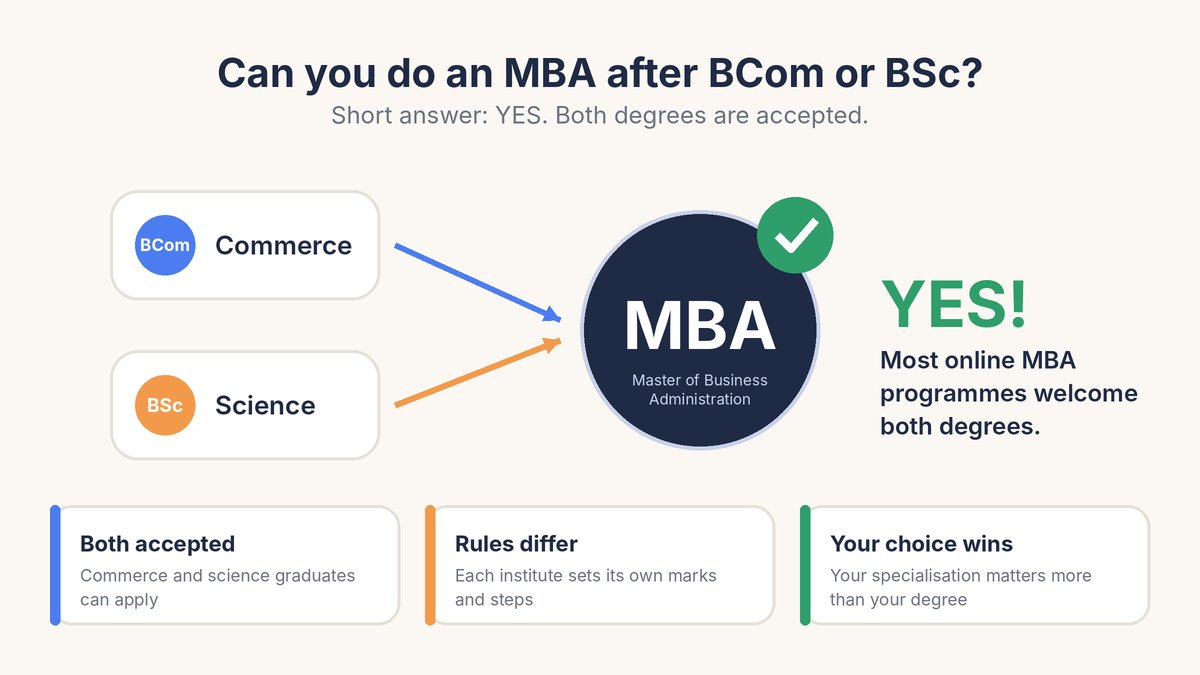
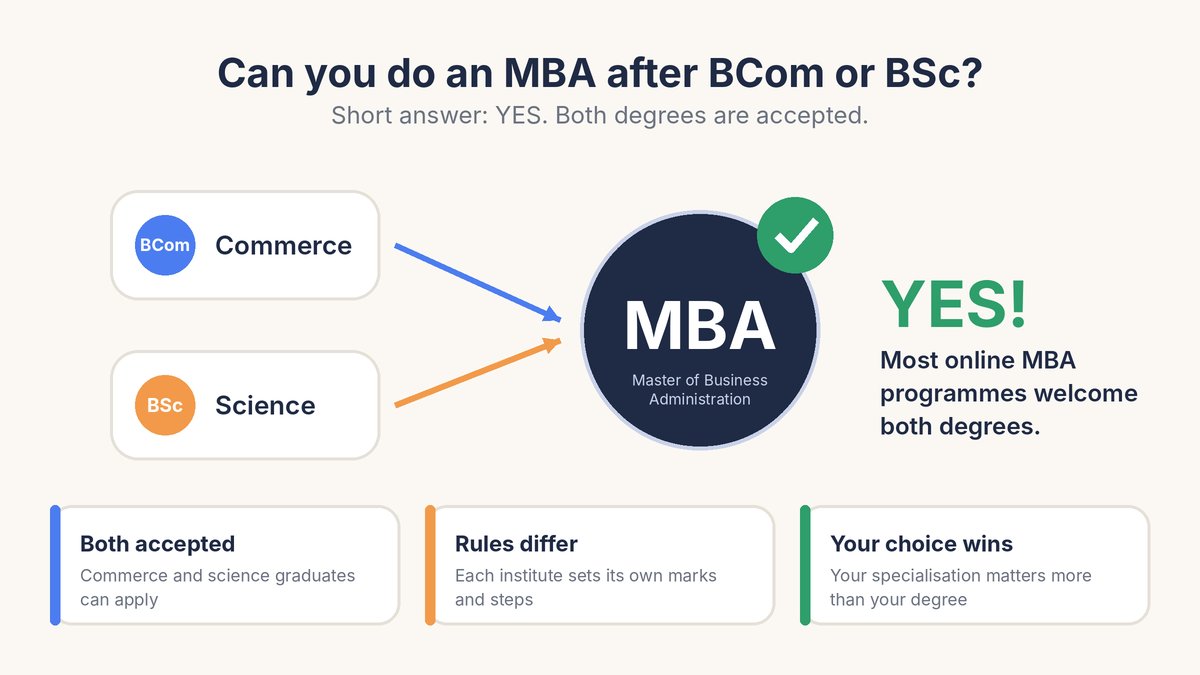
Bachelor’s degree of minimum 3 years from any recognised university.
Marks requirement varies for each institution, so there is no particular figure for all.
Guidelines are subject to change each year, so make sure to check the official site of your favourite institution.
Final-year students are mostly allowed to apply, provided that they complete their degree on time.
Fresh graduates vs experienced candidates
Yes, fresh graduates can join many MBA programs. Is it possible to do MBA without working even after graduating with BCom? Yes, in most MBA programs. In case of executive MBA, things are different as these may require work experience.
Regular MBA: Mostly open to fresh graduates without work experience.
Executive MBA: Work experience might be required in a few years.
Final-year students: Many institutions accept final-year applicants, however admission is conditional till degree completion.
Entrance exams in brief
Many MBA programs ask for scores from exams like CAT, XAT, CMAT, MAT, NMAT or SNAP. Not every program does. Some online programs use their own admission process. The BDU Online MBA, for example, follows four steps: register online, upload documents, get your eligibility verified, and pay the fee.
How your degree shapes your MBA choice
Your degree helps in some subjects, but it never locks you out. A BCom graduate may find accounting easy, while a BSc graduate may find data easy. Each group has a few gaps to fill, and both can be filled with a little practice.
Basis | BCom graduates | BSc graduates |
Usually strong in | Accounting, tax, economics, business law | Maths, logic, working with data |
Often need to learn | Statistics, data tools, coding | Accounting, business terms, business law |
Natural MBA fits | Finance, Marketing, HR, Operations | Analytics, Finance, Operations, Systems |
First thing to learn | Statistics and Excel | Accounting basics |
What BCom gives you, and what it leaves out
Gives you: Accounting, tax, economics and business law. These help a lot in MBA subjects like finance and costing.
May leave out: Statistics, data tools and coding. This depends on your university’s syllabus, so check what you actually studied.
What BSc gives you, and what it leaves out
Gives you: Maths, logic and comfort with data. These help in subjects that use numbers and reports.
May leave out: Accounting, business terms and business law. This also depends on your syllabus, and you can pick these up with a little effort.
Build Your Management Skills with BDU Online Planning an online MBA course after BCom or BSc? The Online MBA at Bharathidasan University (BDU Online) is a two-year program made for working graduates and anyone who needs flexibility. It combines live and recorded lectures with hands-on tools, so you can build practical skills for the specialisation you choose. Key Highlights Recognition: UGC entitled, NAAC A+, AICTE approved and DEB approved. Five Electives: Choose from Finance, Human Resources, Marketing, Operations and Systems. Flexible Learning: Study through 100+ live lectures and recorded sessions on one learning platform, in just 8-10 hours a week. Hands-On Tools: Work with Excel, Tableau and Power BI, plus 34+ hours of soft skill training. Career Guidance: Get help with resume writing, interview skills and what recruiters look for. Program Fee: ₹91,000 for the full 2-year program.
Explore BDU Online and take the next step towards your management education. |
Best MBA specialisations for BCom graduates
There is no single best choice. Many MBA courses after BCom are open to you, and each fits a different type of person. Each section below uses the same layout, so you can compare them easily and find the one that suits you.
MBA in Finance (and Banking and Financial Services)
This is the most natural link to your BCom subjects.
What you study: Corporate finance, banking, credit and risk.
Who it suits: People who like numbers, money and careful decisions.
Your BCom advantage: Accounting and economics.
Your likely gap: Financial modelling and valuation.
Common roles: Financial analyst, credit analyst, relationship manager.
MBA in Business Analytics
This is good for BCom students who like numbers and want to learn data skills.
What you study: Statistics, data visualisation and forecasting.
Who it suits: People who enjoy finding patterns in numbers.
Your BCom advantage: Comfort with business numbers.
Your likely gap: Statistics, SQL, and tools like Python or Power BI. Be ready for extra work here.
Common roles: Business analyst, reporting analyst, BI analyst.
MBA in Marketing
This fits people who like talking to customers and sharing ideas.
What you study: Consumer behaviour, branding, sales and digital marketing.
Who it suits: Communicators and customer-focused students.
Your BCom advantage: Pricing and finance sense.
Your likely gap: Creativity and digital tools. Many marketing roles now use data too.
Common roles: Brand executive, digital marketer, market research analyst.
MBA in Human Resource Management
This fits people who enjoy working with others.
What you study: Recruitment, training, performance and compensation.
Who it suits: People-focused students.
Your BCom advantage: Payroll and compensation basics.
Your likely gap: Behavioural and people skills.
Common roles: HR executive, recruiter, L&D executive.
MBA in Operations and Supply Chain
This fits people who like making work run smoothly.
What you study: Supply chain, procurement, logistics and quality.
Who it suits: Process-minded students.
Your BCom advantage: Cost accounting.
Your likely gap: Supply chain basics and operations analytics.
Common roles: Operations executive, supply chain analyst, procurement executive.
MBA in International Business
This fits students who are curious about trade and global companies.
What you study: International marketing, global finance and export-import.
Who it suits: Students interested in trade and global firms.
Your BCom advantage: Trade and foreign exchange basics.
Your likely gap: Cross-cultural skills. Please note that this course does not promise overseas jobs.
Common roles: Export executive, international business executive.
Best MBA specialisations for BSc graduates (by stream)
BSc graduates have good options too, but fewer articles talk about them. Your stream often points to the best fit. Finance is also open to BSc graduates, but they need to learn accounting basics first.
Stream guides the fit: Maths, computer science, physics, chemistry and life sciences each lead naturally to different MBA paths.
Finance is possible: BSc graduates can study Finance, but they should learn accounting basics before they start.
Learn the business side: Business terms, accounting and presentation skills are the usual gaps for science graduates.
Check the course list: Some sector MBAs are offered by only a few institutes, so always confirm before you apply.
Stream | Best fit | Why | Learn first |
Maths or Statistics | Analytics, Finance | Strong data and logic base | Accounting basics |
Computer Science or IT | Analytics, IT management, Product, Operations | Comfort with technology and data | Business and finance terms |
Physics or Chemistry | Operations, Analytics | Process thinking and problem solving | Accounting, presentation skills |
Life Sciences, Biotech or Agriculture | Healthcare, Pharma or Agri-business management, plus HR and Marketing | Knowledge of a specific sector | Accounting, data basics |
BSc Maths or Statistics
Your strong data and logic base fits data-heavy MBAs well. The best fits are Analytics and Finance. Learn accounting basics first, so that finance terms feel easy from day one.
BSc Computer Science or IT
Your technology background fits analytics and technology roles. The best fits are Analytics, IT management, Product and Operations. Learn business and finance terms first, so you can speak the language of managers.
BSc Physics or Chemistry
Your problem-solving habit fits process and analytics roles. The best fits are Operations and Analytics. Learn accounting and presentation skills first, because MBA work needs clear speaking and simple money maths.
BSc Life Sciences, Biotech or Agriculture
Your subject knowledge fits sector-based MBAs. The best fits are Healthcare, Pharma or Agri-business management, plus HR and Marketing. Not every institute offers these sector MBAs, so check the course list first. Learn accounting and data basics too.
Close your skill gap before you start
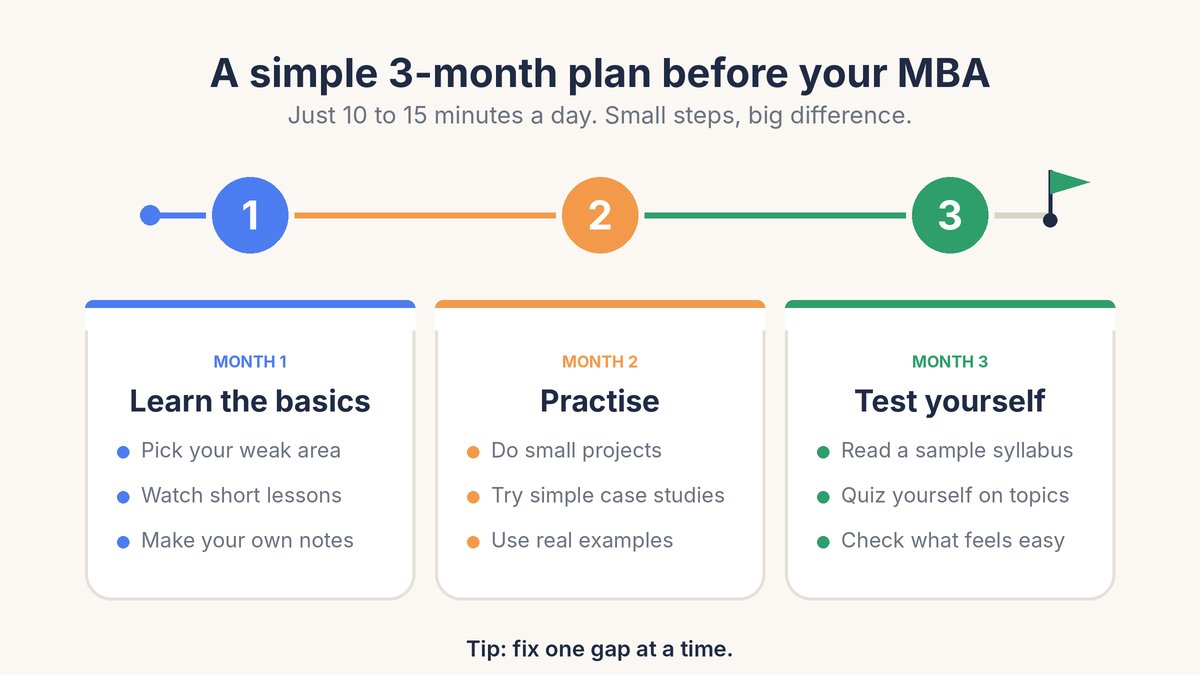
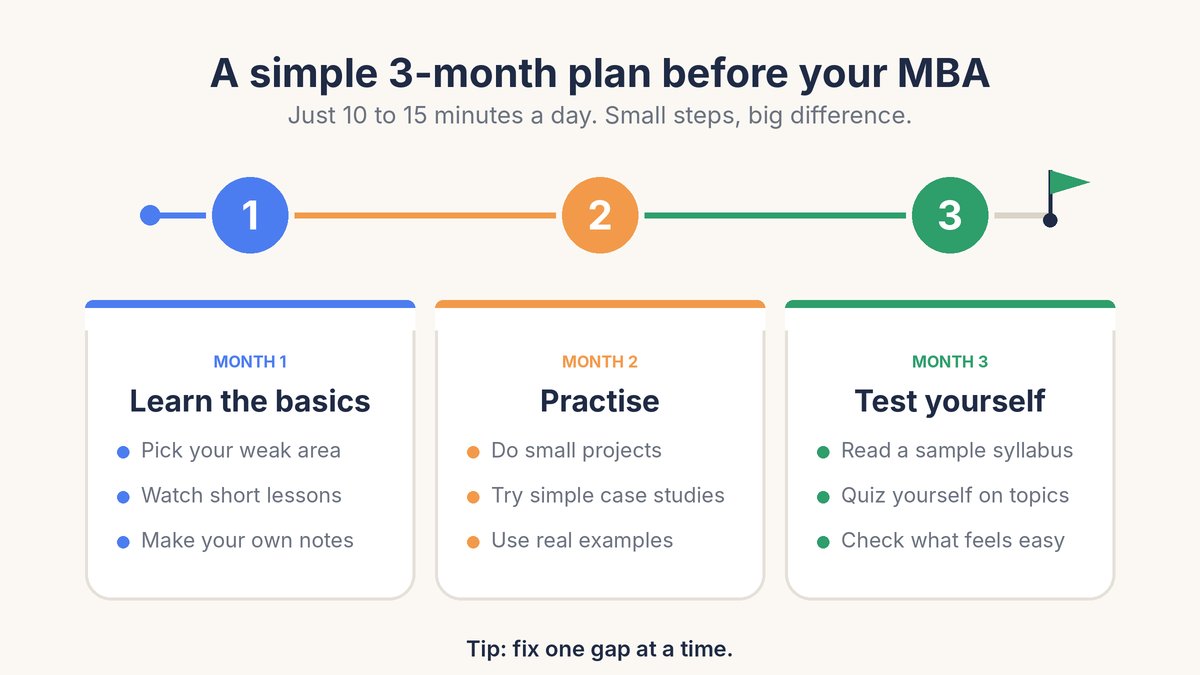
Every graduate has a few gaps, and that is normal. A short, steady plan before the MBA starts makes the first semester much easier. Use the lists below to find your gaps, then follow the 3-month plan.
Know your gaps first: Write down what your degree did not teach you. Then fix one gap at a time.
Start small: Ten to fifteen minutes a day is better than one long weekend of study.
Practise with real examples: Use small cases like a family shop’s accounts or a simple sales sheet.
Test yourself: Check your progress every month with a short quiz or a mini project.
For BCom graduates
Statistics basics: Learn averages, spreads and simple charts.
Advanced Excel: Practise formulas, pivot tables and clean-up tools.
SQL: Learn to pull data from a table with simple commands.
Power BI or Tableau (for Analytics): Build simple dashboards from sample data.
For BSc graduates
Accounting basics: Understand balance sheets, profit and loss, and simple budgets.
Business terms: Learn words like revenue, margin, market share and cash flow.
Communication and presentation skills: Practise explaining an idea clearly in two minutes.
A simple 3-month plan for everyone
Month 1: Learn the basics of your weak area. Watch short lessons and make your own notes.
Month 2: Practise with small projects or case studies. Apply what you learned to real examples.
Month 3: Read a sample syllabus of your chosen specialisation and test yourself on the topics.