Which Between CFA, FRM, and CMA Certification Should One Choose After Graduation from MBA in Finance Program?
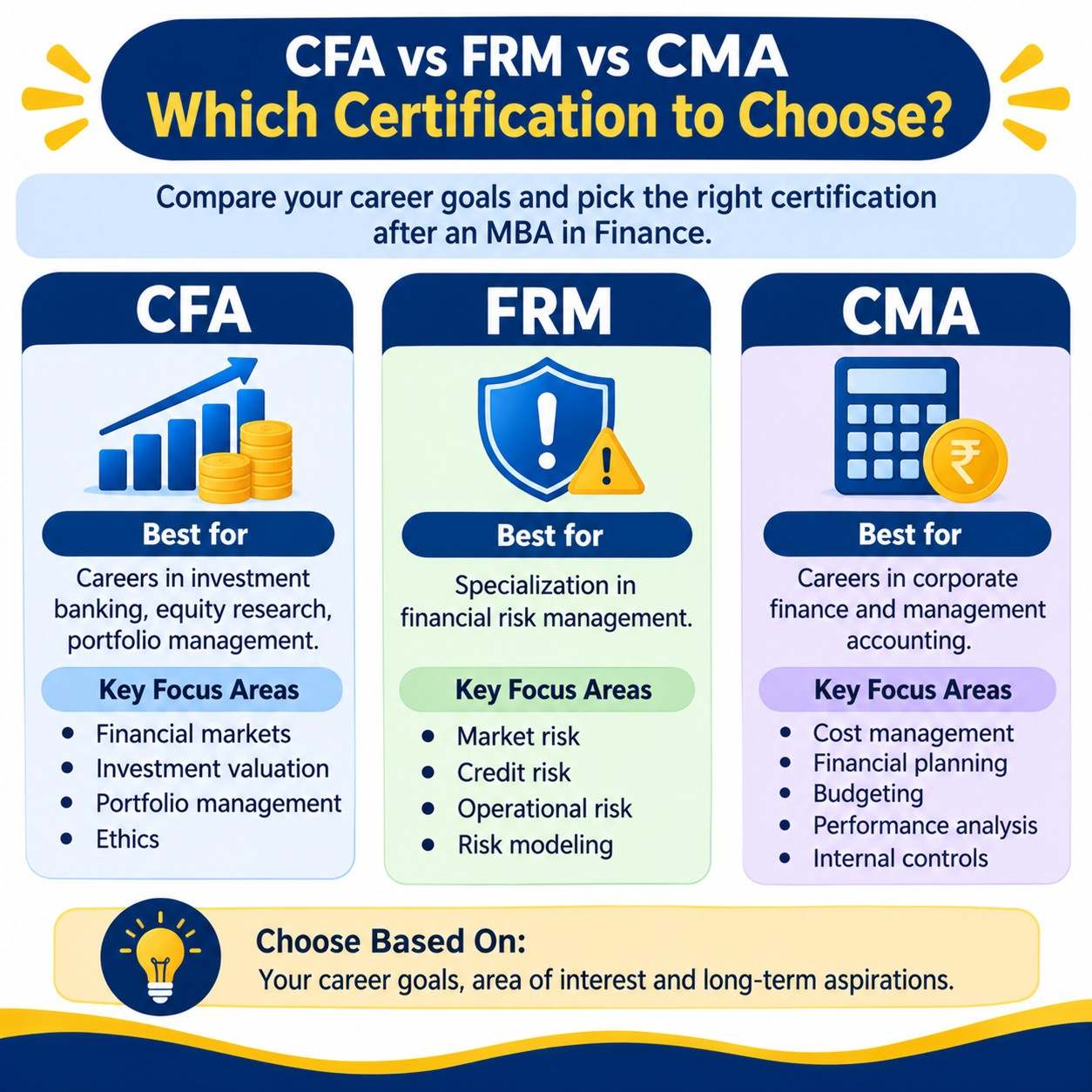
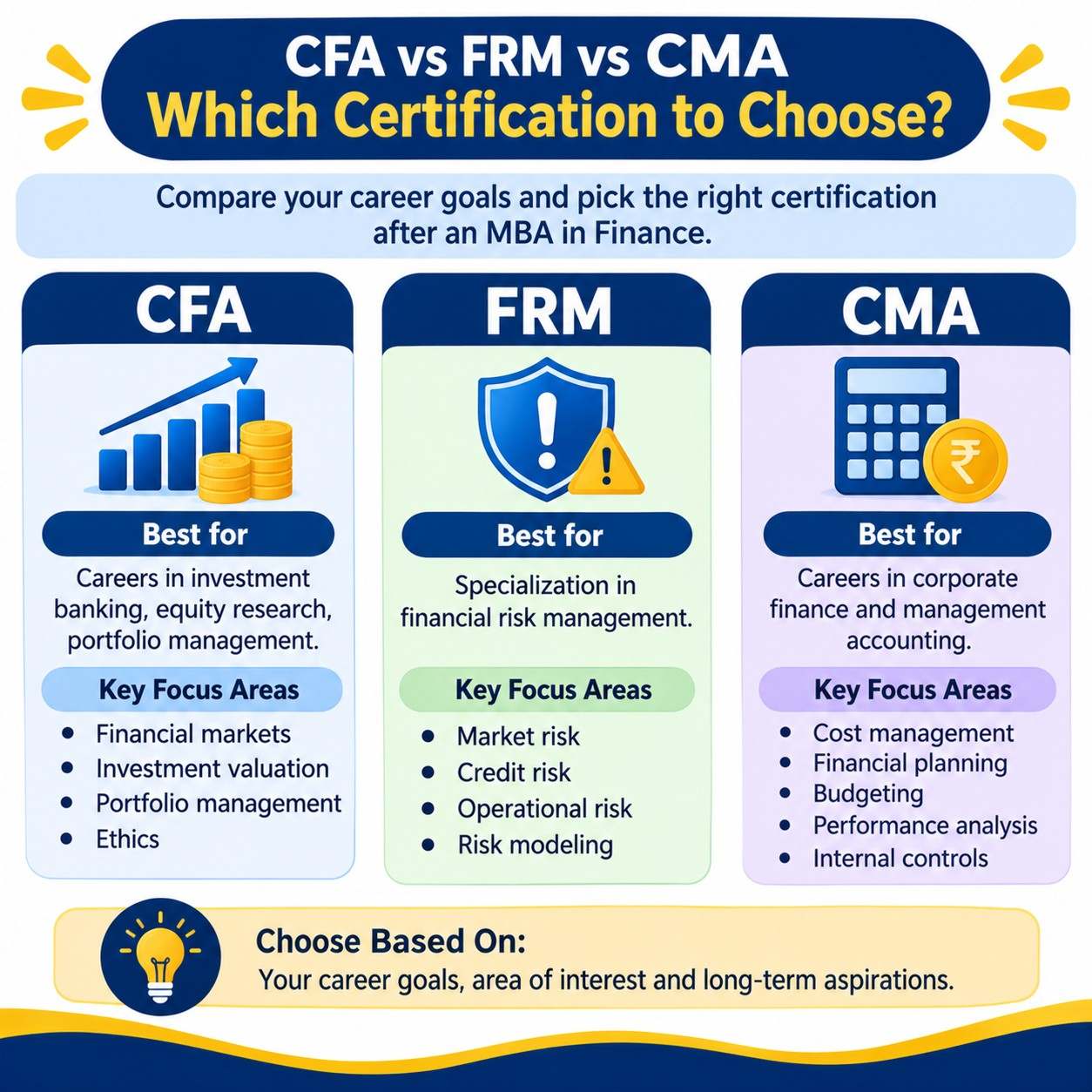
CFA, FRM, and CMA are some common certifications available that will allow students who have graduated with MBA in Finance to acquire specialized knowledge and work in various fields. But each one of them emphasizes various aspects of finance. Selection should depend on one’s career aspirations, specialization, etc.
CFA: CFA certification is relevant for those graduates who wish to pursue careers in investment banking, equity research, portfolio management, and investment analysis. It emphasizes financial markets, investment valuation, portfolio management, and ethics.
FRM: FRM certification is appropriate for those graduates who are interested in specialization in financial risk management. It includes market risk, credit risk, operational risk, risk modeling, and financial risk assessment.
CMA: CMA certification is relevant for those graduates who are interested in specialization in corporate finance, management accounting, budgeting, and financial planning. It emphasizes cost management, financial decision-making, performance analysis, and internal controls.
Which one is for you?
Select CFA if you would like to specialize in investment management, equity research, and investment banking.
Select FRM if you are more concerned about banking risk, financial risk, and risk management.
Select CMA if you would like to focus on corporate finance, financial planning, management accounting, and cost management.
All of the certifications provide different career paths. It is important not to be biased toward the choice by their popularity but rather by your needs in skills and finance positions.
Build Your Financial Management Expertise with Bharathidasan University An MBA in Finance opens career opportunities in banking, investment management, corporate finance, and financial consulting. The Online MBA program from Bharathidasan University helps learners build business and management knowledge while developing an understanding of financial concepts and business decision-making. Key Learning Areas: Financial Planning and Analysis Investment and Risk Management Corporate Finance and Budgeting Business Strategy and Decision-Making
Explore the Online MBA program at Bharathidasan University, recognised by UGC-DEB and offered by a NAAC A+ accredited university, to strengthen your management knowledge. |
How to Select the Best Suitable Certificate According to Your Career in Finance
To select the appropriate certificate in finance depends on your career interest, specialization, and career goals. Each type of certificate is useful in acquiring a certain set of financial skills. Consider the following important points before enrolling yourself into a certification program:
Determine your career interest: Determine your career interest in finance such as investment banking, financial planning, risk management, corporate finance, and investment research.
Specialization in field: Decide to obtain CFA certificate in investment management, FRM in financial risk management, and CMA in corporate finance and management accounting.
Eligibility criteria: Check out the educational requirements, work experience, examination and other criteria for a particular type of certification.
Course duration and fees: Examine examination fee, time period for examination preparation and other costs.
Industry demand: Conduct some research in order to know the demand of certain certificates in your desired industry and required skills for the job role.
Career growth: Select the best suitable certificate according to your career path in finance.
What Are The Industries That Hire MBA Finance Graduates?
There are many industries which require hiring finance specialists for handling their financial operations, planning and investments. Many industries hire MBA Finance graduates for these roles.
Industry | Job Titles | Major Responsibilities |
Banking & Financial Services | Financial Analyst, Credit Analyst, Relationship Manager | Evaluation of loans, analysis of the financial performance and transaction management. |
Investment Banking | Investment Banker, Equity Research Analyst | Investment management, mergers and acquisition and security analysis. |
Insurance | Risk Analyst, Underwriting Manager | Risk evaluation and assessment of insurance policies. |
Information Technology (IT) | Finance Manager, Business Finance Analyst | Budget management, expense analysis and financial operations monitoring. |
Consulting | Financial Consultant, Risk Consultant | Advisory service related to financial planning, investments and costs management. |
Manufacturing | Cost Analyst, Budget Analyst | Production cost monitoring, budget management and financial operations improvement. |
E-commerce and Retail | Revenue Analyst, Treasury Analyst | Revenue analysis, cash flow monitoring and financial forecasting. |
Asset Management | Portfolio Manager, Investment Analyst | Portfolio and financial assets management and evaluation. |
Corporate Sector | Corporate Finance Manager, Treasury Manager | Financial planning, capital allocation and investments decisions management. |
Why Should One Choose for Bharathidasan University’s Online MBA Program?
There are many factors that make Bharathidasan University the right choice for graduates to pursue their Online MBA program as it helps them gain management skills while keeping their personal and professional life on track. Some reasons to choose the Online MBA of Bharathidasan University include:
UGC Recognition: The Online MBA program of Bharathidasan University is recognized by UGC-DEB.
NAAC Accreditation: The university has an A+ accreditation grade at the institutional level from NAAC.
Flexible Learning: With the online mode of learning, students can access study materials and study accordingly along with personal and professional commitments.
Curriculum: The Online MBA program curriculum emphasizes knowledge in business and management which is required in professional life.
Qualified Faculty: Students will get a chance to learn from qualified faculty members for getting academic support.
Practical Learning: Practical learning through projects and assignments in an online education system of the university is emphasized.
Conclusion
MBA Finance allows you to get into different career options, including careers in banking, investment management, corporate finance, and consulting. You have the chance of exploring career options like that of a Financial Analyst, Investment Banker, and Finance Manager, with salaries being dependent on experience and knowledge. Getting yourself certified through programs such as CFA, FRM, and CMA will allow you to specialize yourself and build a better career.